I started learning Japanese one month before I came to Japan. That sounds like a head start until you realize how much Japanese I understood when I arrived. For roughly the first year, I didn't understand much at all.
What eventually helped was learning how the language worked. I looked for resources online that explained the grammar and its exceptions, then tried making my own sentences. I wrote them down, said them out loud, and asked Japanese friends to correct me. I also practiced a lot with the person who was my boss at the time and is now my wife. Somewhere along the way, I started thinking in Japanese.
A lot of people want to live in Japan, and I understand why. Knowing the language can make everyday life easier and open doors: talking with people, handling things for yourself, and understanding more of what's happening around you. You don't have to speak perfectly to start. You do need a way to practice that lets you say more than what happens to be printed in a phrasebook.
Learn the rule, then make it yours
A list of useful phrases can get you through a conversation. But if all I do is memorize a sentence and its translation, what happens when I want to change one part of it? I can either hope the next page has the exact sentence I need, or learn how the first one was put together.
That's why I recommend that adults learn grammar patterns and their exceptions, then practice using them. You can take a structure, replace words, make mistakes, and learn from the corrections. The goal is to understand what you're saying well enough to make a new sentence of your own.
Children often learn while surrounded by a language all day, every day. An adult studying around work and everything else may not have that kind of exposure. Rules can give you a useful starting point; listening and using the language help you get comfortable with it. Research on explicit language instruction also supports teaching rules, though people learn in different ways.
Start with one pattern
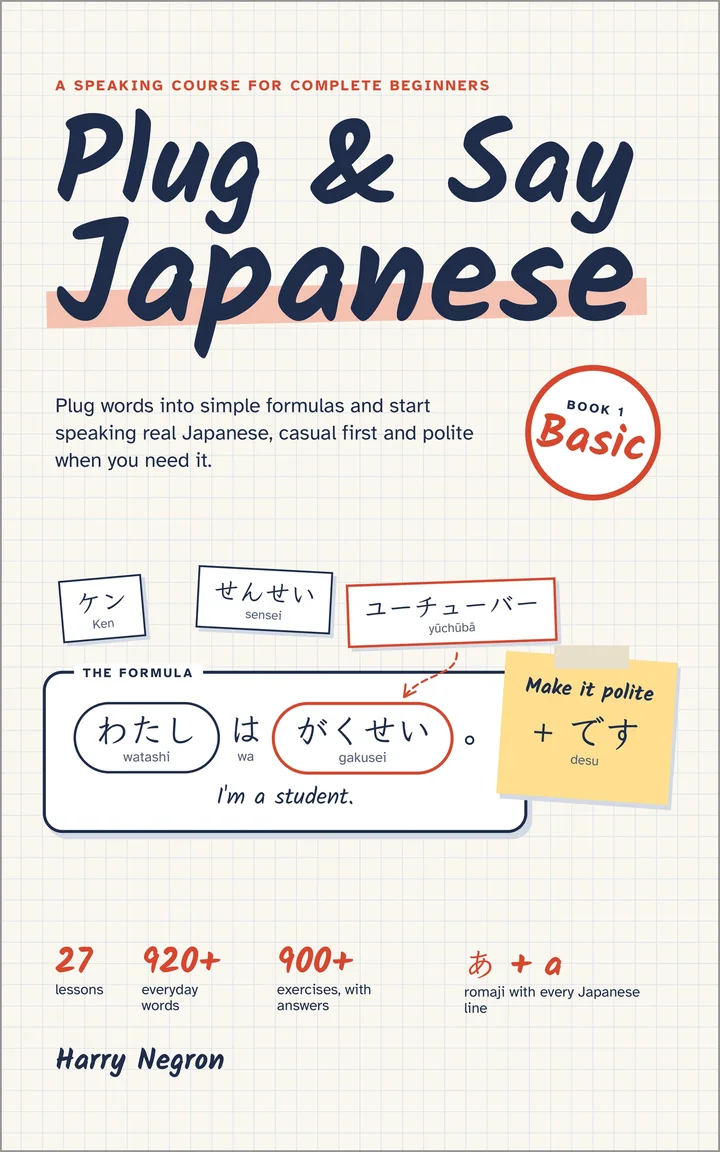
One of the first patterns I teach is A は B です (A wa B desu). The particle は is written with the character ha here, but pronounced wa. It marks what you're talking about. For a simple introduction, you can use the pattern like this:
私は学生です。
Watashi wa gakusei desu.
I'm a student.
Swap the word for student with enjinia, and 私はエンジニアです (Watashi wa enjinia desu) means “I'm an engineer.” You have a pattern you can use with other nouns you learn. The context and the rules around each pattern still need attention, but now you have something to experiment with.
In the first lesson on my YouTube channel, I walk through this basic sentence structure.
Ask a question and keep going
Once you can build a simple sentence, questions give you a reason to use it with someone else. For example, これは何ですか? (Kore wa nan desu ka?) means “What is this?” You can point at something, ask the question, and then listen to the answer.
My second lesson introduces words such as nani (what), dare (who), and doko (where), and how to ask questions in Japanese.
Don't worry if the first few attempts come out slowly. Pick a pattern, learn a few words that fit it, and make sentences you actually want to say. Then try them out. If you have a Japanese-speaking friend, ask whether your sentence sounds natural and what they would change. Listen to the answer and try again.
If you don't have someone to ask yet, write or record your sentences and compare them with reliable examples. Keep listening, and look for opportunities to get feedback as you continue.
Let people correct you
My friends had plenty of opportunities to help me. They kept correcting my sh and ch sounds. Spanish is my native language, and I wasn't used to distinguishing those sounds in Japanese, so I mixed them up quite a bit. Apparently, I had found one more way to make the conversation interesting.
Getting corrected is part of the practice. A rule helps you build the sentence; another person can tell you whether what came out of your mouth was the sentence you thought you built.
Why I wrote Plug & Say Japanese
I've seen how many people are interested in living in Japan, and I know how much easier life can be when you can talk to the people around you. I wrote Plug & Say Japanese: Basic to give beginners a place to learn patterns, build vocabulary, and practice making their own sentences.
The English-language book includes sentence maps, examples, exercises, and both casual and polite forms. It uses Japanese text alongside romaji, so you can start practicing while you work on reading. Think of it as a beginning: take the patterns, put them to work, and keep expanding what you can say.
You don't have to wait until you know everything before you speak. Learn one rule, make a sentence, let someone correct it, and make another. At some point you may notice you're spending less time translating in your head. And hopefully your friends won't have to correct your sh and ch sounds as often as mine did.